


Aluminum PCB Assembly Services
SMT, THT and manual assembly of aluminum-core boards, with reflow matched to the board and inspection built in.

Aluminum PCB Sourcing and Assembly Services Within Our EMS Production
Steiner Elektronik provides aluminum PCB assembly services for electronic products that need the heat dissipation and mechanical rigidity of a metal-core board. We handle aluminum-core boards within the same EMS production as our standard SMT and THT work.
We have strong experience in sourcing aluminum PCBs and work with trusted suppliers for these specialised board types. We can coordinate PCB sourcing together with component procurement and assembly, giving you one production process from prototype to series production.
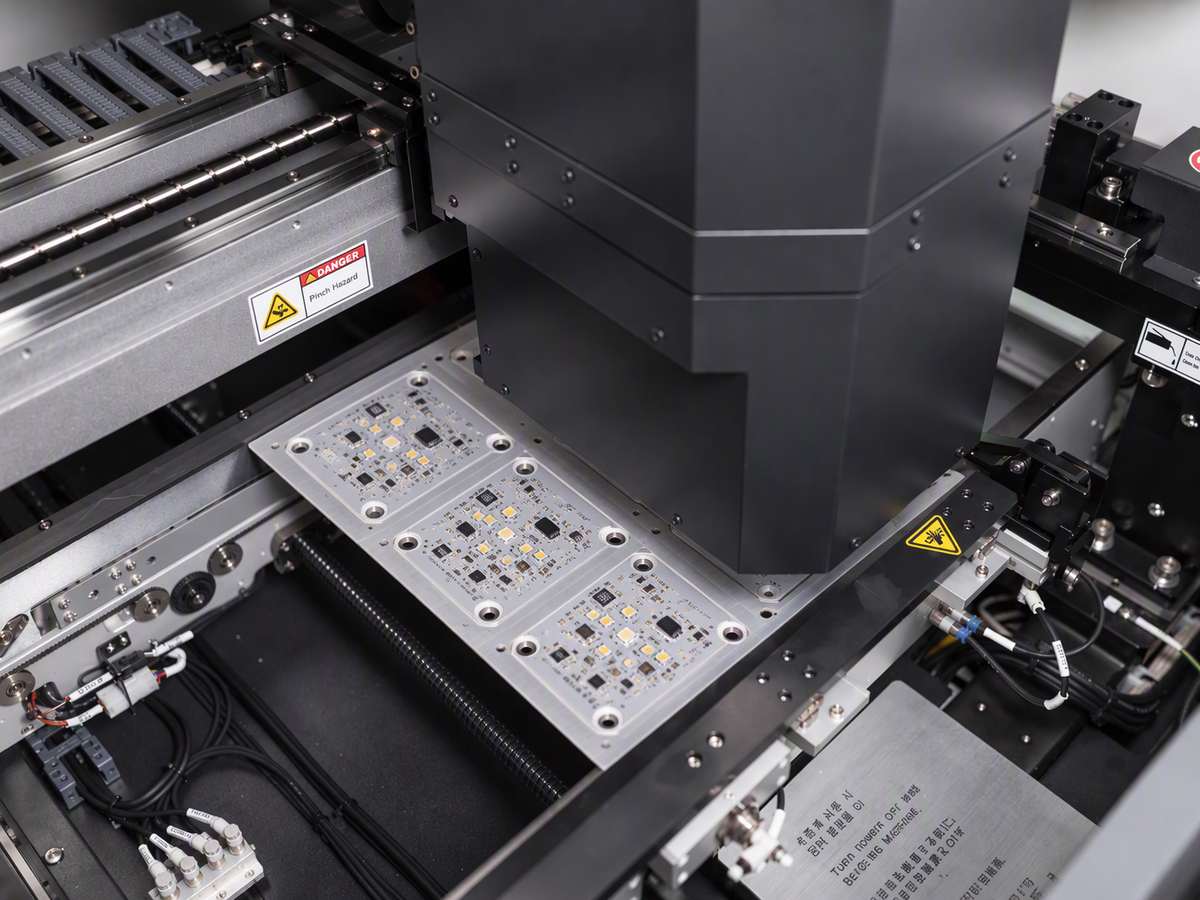
What is an Aluminum PCB and Why Use It?
An aluminum PCB, often called a metal-core PCB (MCPCB), is a printed circuit board built on an aluminum base layer rather than the glass-reinforced epoxy used in standard FR-4. A thin dielectric layer sits between the aluminum base and the copper circuit layer. The heat generated by the components moves through the dielectric into the aluminum, which then spreads and dissipates it.
The use of an aluminum base does not make the assembly process fundamentally different from conventional PCB assembly, but it does require specific thermal and soldering considerations.
Aluminum PCB vs. Standard FR-4 PCB
The main difference between aluminum and FR-4 PCBs is the base material. The aluminum base changes how the board handles heat, how it behaves mechanically, and how the assembly process has to be adjusted.
| Factor | Aluminum PCB | Standard FR-4 PCB |
|---|---|---|
| Base Material | Aluminum core with dielectric and copper layer | Glass-reinforced epoxy with copper layers |
| Thermal Conductivity | High, moves heat away from components | Low, heat stays close to the components |
| Mechanical Rigidity | High, resistant to flex | Moderate, depends on thickness |
| Layer Options | Most designs are single-sided; double-sided and multilayer are possible but less common | Single-sided, double-sided and multilayer are all standard |
| Weight | Heavier for the same board size | Lighter |
| Typical Use Cases | LED lighting, power electronics, motor drives, EV and automotive electronics | General electronics, control boards, communication equipment, consumer products |
| Assembly Considerations | Reflow profile and handling adjusted for thermal mass | Standard reflow and handling |
| Cost | Higher per board | Lower per board |
In practice, the choice is driven by thermal and mechanical requirements rather than cost. When the design needs to move heat away from components, an aluminum PCB is often simpler than adding heatsinks, fans or thermal pads to an FR-4 board.
What We Consider Before Production
Aluminum PCBs require attention to the board construction and thermal properties during assembly. While the basic SMT and THT processes remain largely the same as for standard PCBs, certain characteristics of aluminum-core boards can influence production planning and handling.
Thermal Management Considerations for Aluminum PCB Assembly
The aluminum base influences how heat is distributed across a PCB during soldering. Compared with standard FR-4 boards, aluminum-core PCBs can behave differently during reflow because the metal substrate transfers heat away from certain areas of the board.
This can affect soldering conditions, particularly for assemblies with power components, LEDs or components connected to areas with high thermal mass. The board construction, component layout and thermal characteristics therefore need to be considered when planning the assembly process.
At Steiner Elektronik, these factors are relevant when planning the assembly of aluminum-core PCBs. The applicable production parameters depend on the specific board design and component requirements.

Testing and Quality Control for Aluminum PCB Assembly
For aluminum PCB assemblies, additional testing may be performed according to customer requirements and the specific application. For LED and power electronics assemblies, this may include thermal testing to evaluate temperature behaviour under defined operating conditions.
Our inspection and testing capabilities also include SPI, 3D AOI, X-ray inspection, ICT and functional testing, depending on the project requirements.
For more information, please visit our Testing, X-Ray & Programming page.
Typical Applications for Aluminum PCB Assembly
Aluminum PCB assembly services are chosen where heat dissipation, mechanical rigidity or component life drives the design. The combination of high thermal conductivity and physical strength makes aluminum PCBs the standard choice in several specific industries.
Typical applications where aluminum PCB assembly is the right choice include:
Why Choose Steiner Elektronik for Aluminum PCB Assembly Services
As your EMS partner, we manage every stage of an aluminum PCB project in-house, from sourcing and procurement through assembly, inspection, testing and delivery.
Experience with Aluminum PCB Assembly: We have practical experience assembling aluminum-core PCBs and understand the production considerations involved.
What to Send Us for a Quote
Complete project information helps us review your aluminum PCB assembly requirements, determine suitable production processes and prepare an accurate quotation.
FAQ
What is an aluminum PCB?
An aluminum PCB is a printed circuit board built on an aluminum base layer with a dielectric and a copper circuit layer on top. The aluminum base moves heat away from the components, which makes aluminum PCBs well suited to LED, power and other thermally stressed designs.
When should I choose an aluminum PCB over FR-4?
Choose an aluminum PCB when heat dissipation, mechanical rigidity or component life matters more than cost. LED lighting, power converters, motor drives and automotive electronics are typical cases. If thermal performance is not a design driver, FR-4 is usually the simpler and cheaper choice.
Can aluminum PCBs be assembled using SMT?
Yes. Aluminum PCBs are routinely assembled on our automated JUKI SMT lines with reflow soldering. The core SMT process is the same as for FR-4 boards, with the reflow profile adjusted for the aluminum-core thermal mass.
Can Steiner Elektronik handle double-sided aluminum PCBs?
Yes. Most aluminum PCBs are single-sided, but we can also assemble double-sided aluminum designs where the construction and components allow it.
Does aluminum PCB assembly require special soldering?
It uses the same soldering technologies as conventional PCB assembly, with reflow for SMT, and selective, wave or manual soldering for THT. What changes is the reflow profile and the process parameters, which we adjust to suit the aluminum base and the components on the board.
Does aluminum PCB require a different assembly process?
Not necessarily. SMT and THT assembly technologies are fundamentally the same, but the thermal and material characteristics of an aluminum PCB may require specific consideration during soldering, component selection and process setup.
Is aluminum PCB assembly suitable for prototypes, small batches and series production?
Yes. We assemble aluminum PCBs from prototypes and small batches through to series production on the same SMT lines, with reflow profiles and inspection setups developed for the specific design. The same equipment and processes apply across all volumes, so a prototype build and a series-production build use the same inspection and quality control.

Get in Touch
Your electronics – our passion